
Breathiterol Supplement Facts: Panel Transcript, Serving Math and Blend Limits
Every word of the label, rebuilt from the seller's image, followed by the arithmetic it allows: spray volume, blend floors and ceilings, and the 100-serving bottle the order page calls a 30-day supply.
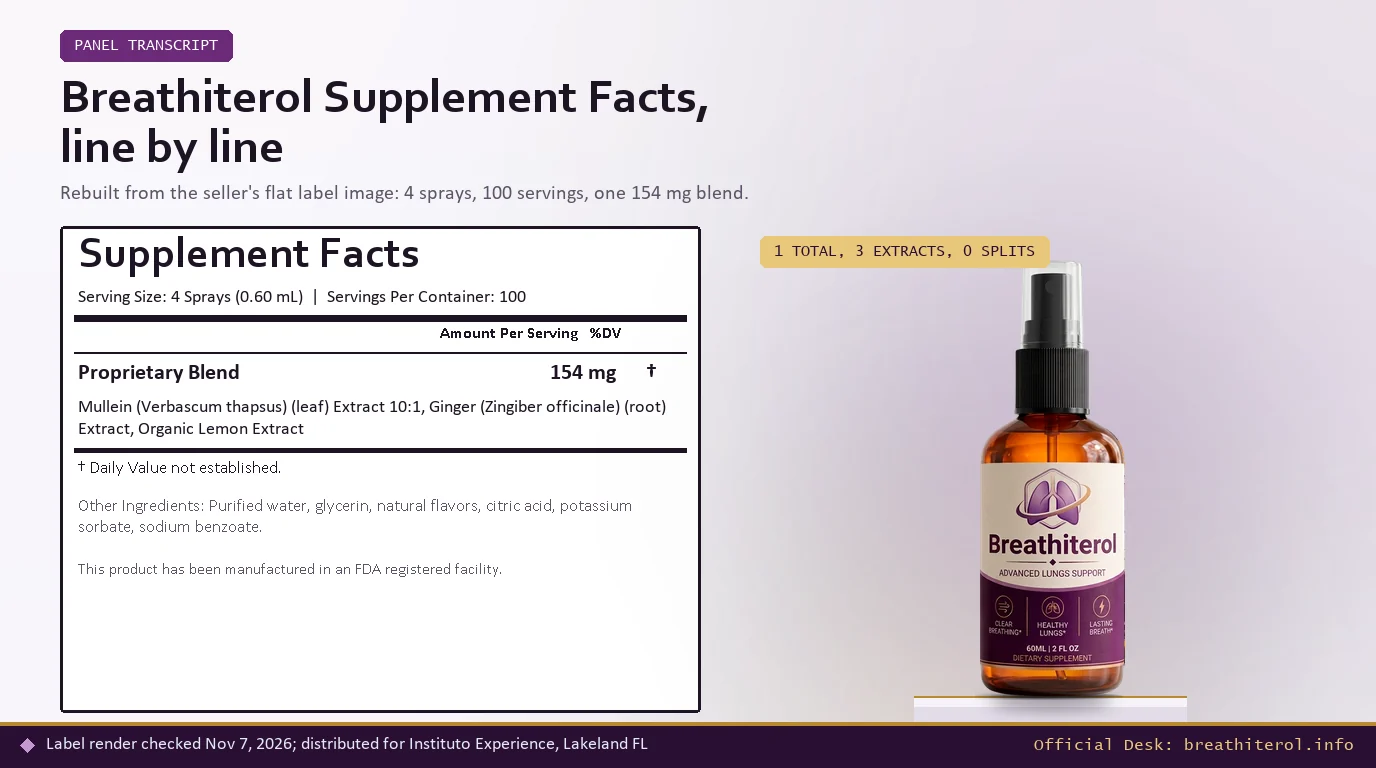
The panel, transcribed
The seller's home page shows the label as one flat image with three panels: directions and cautions on the left, the brand and claims in the middle, Supplement Facts on the right. We typed it out, compared it twice, and rebuilt the Facts box below so it can be read on a phone. Nothing has been added or rounded.
Supplement Facts
Servings Per Container: 100
Other Ingredients: Purified water, glycerin, natural flavors, citric acid, potassium sorbate, sodium benzoate.
Under the box the label prints the standard FDA statement (“These statements have not been evaluated by the Food and Drug Administration. This product is not intended to diagnose, treat, cure, or prevent any disease.”) and one more line: “This product has been manufactured in an FDA registered facility.”
The left panel
- Suggested use: shake well before each use; spray 4 pumps directly into mouth or onto tongue once daily.
- Storage: keep away from heat, light and humidity to preserve freshness.
- Caution: do not exceed recommended dose; pregnant or nursing mothers, children under the age of 18 and individuals with a known medical condition should consult a physician before using this or any dietary supplement.
- Keep out of the reach of children. Do not use if safety seal is damaged or missing. Store in a cool, dry place.
- Made in the USA with globally sourced ingredients.
- Distributed for: Instituto Experience, Lakeland FL 33804, +1 (507) 448-8190, [email protected].
The front panel
The brand name with a lungs-in-a-hexagon logo, “Advanced Lungs Support”, three icons reading Clear Breathing*, Healthy Lungs* and Lasting Breath*, and “60ML | 2 FL OZ, Dietary Supplement”.
Serving math: sprays, millilitres and milligrams
The panel gives enough numbers to work out the rest:
| Quantity | Value | How it is derived |
|---|---|---|
| One spray | 0.15 mL | 0.60 mL divided by 4 sprays |
| Blend per spray | 38.5 mg | 154 mg divided by 4 |
| Blend concentration | about 257 mg per mL | 154 mg in 0.60 mL |
| Servings per bottle | 100 | 60 mL divided by 0.60 mL, as printed |
| Blend per bottle | 15.4 g | 154 mg times 100 servings |
| Days per bottle at the label dose | 100 | one serving a day |
| Days per bottle as sold | 30 | order page: 2 bottles = 60-day supply |
The last two rows do not agree, and the label wins. Selling a 100-serving bottle as a month's supply would mean using about 13 sprays a day, more than three times the printed serving. The label also says “do not exceed recommended dose,” so the 30-day framing is best read as a pricing convention, not dosing advice. If you follow the label, each bottle lasts about three months.
Reading a proprietary blend
A proprietary blend lets a company list a total and the ingredient names without the amount of each. The rule that limits this secrecy is the order: ingredients in a blend must be listed in descending order of predominance by weight [1]. With three ingredients that rule yields hard limits:
- Mullein leaf extract, first, must be at least as heavy as each of the others, so at least 154 ÷ 3 = 51.3 mg.
- Ginger root extract, second, cannot exceed mullein, so at most 154 ÷ 2 = 77 mg.
- Organic lemon extract, third, cannot exceed ginger, so at most 154 ÷ 3 = 51.3 mg.
Those are boundaries, not estimates. A blend of 120 mg mullein, 30 mg ginger and 4 mg lemon would satisfy the label as well as an equal three-way split. For comparison, the one human airway trial of ginger used 2,000 mg a day [5], so even the ceiling sits under 4% of it.
The “10:1” describes how the mullein extract was made, roughly ten parts of dried leaf to one part of extract. It is not a strength guarantee, because the label names no marker compound that would let anyone check it.
Why the panel shows a dagger instead of a percentage
The dagger next to 154 mg points to the footnote “Daily Value not established.” Daily Values exist for vitamins, minerals and a few nutrients such as fiber and protein. Herbal extracts have none, so the column is always blank for them. The dagger is not a warning; it simply means there is no official reference amount to compare against. It does, however, remove one of the easiest ways shoppers judge a supplement, which is why the dose comparisons on this site use published research amounts instead.
The panel also has no nutrition lines such as calories or sugars. Labels may omit nutrients present only in insignificant amounts, and at 0.60 mL a serving the glycerin contributes very little energy.
The other ingredients, one by one
Purified water carries everything. Glycerin sweetens and thickens, and it is a demulcent: it coats the throat, which cough researchers credit for much of the relief syrups provide [6]. Natural flavors are unspecified. Citric acid sets the acidity and freshens the taste. Potassium sorbate and sodium benzoate are preservatives, common in soft drinks and syrups, that keep an opened bottle from spoiling. None of these is unusual; all are standard in liquid supplements.
Notice what is absent: no alcohol, no added sugar, no artificial sweetener listed, no caffeine. People avoiding alcohol for medical or personal reasons should find the base acceptable, but if you are sensitive to benzoates you may want to skip it.
What the front-label claims are allowed to say
“Advanced Lungs Support”, “Clear Breathing”, “Healthy Lungs” and “Lasting Breath” are structure/function claims. Federal rules allow supplements to describe support for normal body function, provided the label carries the FDA disclaimer and the claims stop short of disease [2]. That is why each badge has an asterisk. The same rules mean the product cannot say it treats asthma, COPD, bronchitis or allergies, and the label does not.
The sales page is not so careful. Phrases about reducing “wheeze”, relieving congestion and accelerating “recovery after respiratory crises” edge toward disease territory. The FDA's consumer guidance warns that miracle-style health promises are a common sign of questionable products [8].
“FDA registered facility” and “Made in the USA”
Food and supplement factories must register with the FDA. Registration is a listing, not an inspection result and not an approval of anything made there. The agency does not approve supplements before sale and acts mainly after problems are reported [4]. Factories must still follow current good manufacturing practice rules, which require identity testing of ingredients, batch records and quality control [3]. The label does not name the factory, so there is no way to look up its inspection history.
“Made in the USA with globally sourced ingredients” tells you the spray was mixed and bottled in the United States while the extracts may come from anywhere. That is normal for botanicals, most of which are grown and extracted abroad.
Storage and shelf life
The label asks you to keep the bottle away from heat, light and humidity and to store it in a cool, dry place. The amber glass already blocks much of the light that degrades plant compounds; the rest is up to you. A bathroom cabinet is warm and humid, a car glovebox gets hot, and a sunny windowsill defeats the amber glass. A kitchen cupboard away from the stove is a better spot.
Once the seal is broken, the preservatives protect the liquid, but the pump draws air in with every press. Wipe the nozzle if it gets sticky, close the cap after each use, and do not share the bottle. If the liquid changes color sharply, smells off or shows floating growth, stop using it. No expiry date appears on the label image, so check the physical bottle or box for one when it arrives.
What the label does not tell you
- The milligrams of each extract inside the 154 mg blend.
- Marker compounds or standardization (for example, gingerol content or verbascoside content).
- The plant part and form of the lemon extract.
- The manufacturer's name or address; only the distributor is listed.
- A certificate of analysis or any reference to third-party testing.
- An allergen statement, which matters for people allergic to citrus or ginger.
None of these omissions breaks the rules; they are common in this category. Together they mean you are trusting the distributor's word on identity, strength and purity. NCCIH's advice on using supplements wisely is to ask exactly these questions before buying [7].
The same panel under another name
The Breathiterol panel is almost word for word the panel of a spray sold as Breathizen, also distributed through a Lakeland, Florida company.
| Panel line | Breathiterol | Breathizen |
|---|---|---|
| Serving | 4 sprays (0.60 mL) | 4 sprays (0.60 mL) |
| Servings per container | 100 | 100 |
| Proprietary blend | 154 mg | 154 mg |
| Blend contents | Mullein leaf 10:1, ginger root, organic lemon | Mullein leaf 10:1, ginger root, organic lemon |
| Other ingredients | Water, glycerin, flavors, citric acid, sorbate, benzoate | Same list |
| Distributor on label | Instituto Experience, Lakeland FL | GEX Corp, Lakeland FL |
Identical formulas under different brand names are common in this market. It is worth knowing so that you do not buy both expecting different results.
Read your own bottle: a checklist
When the parcel arrives, take two minutes with the bottle before opening it:
- Is the safety seal intact? The label says not to use the bottle otherwise.
- Does the panel read 4 sprays (0.60 mL), 100 servings, Proprietary Blend 154 mg, with the same three extracts?
- Is there a lot number and an expiry or best-by date printed on the bottle or box? Photograph them.
- Does the distributor line match Instituto Experience, Lakeland FL, with the same phone number?
- Do the other ingredients match the list above?
If anything differs, contact the seller before use and keep the bottle sealed. If a product causes a reaction, you can report it to the FDA through MedWatch [9] or the agency's supplement problem page [10].
More questions on this page
How many sprays are in one Breathiterol serving?
Four. The label sets the serving at 4 sprays, which equals 0.60 mL, taken once a day.
How many servings does a bottle hold?
100, according to the panel. At one serving a day, a 60 mL bottle lasts about 100 days, even though the order page sells each bottle as a 30-day supply.
How much mullein is in Breathiterol?
At least 51.3 mg per serving and up to the full 154 mg, because it is listed first in a three-ingredient blend. The seller does not state the exact amount.
Does the label show a lot number?
The label image does not; lot numbers are usually printed on the physical bottle or box. Photograph yours when it arrives and ask the seller for that lot's certificate of analysis.
Is Breathiterol vegan or gluten-free?
The label does not say. None of the listed ingredients is animal-derived or contains gluten, but without a statement from the seller cross-contact cannot be ruled out.
Where these statements come from
Links open the original paper or agency page. Every study tested an ingredient on its own and usually at a bigger dose; none of them used a Breathiterol spray.
- 1Electronic Code of Federal Regulations. 21 CFR 101.36: Nutrition labeling of dietary supplements (proprietary blend rule in paragraph (c)). www.ecfr.gov/current/title-21/chapter-I/subchapter-B/part-101/subpart-C/section-101.36
- 2Electronic Code of Federal Regulations. 21 CFR 101.93: Certain types of statements for dietary supplements. www.ecfr.gov/current/title-21/chapter-I/subchapter-B/part-101/subpart-F/section-101.93
- 3Electronic Code of Federal Regulations. 21 CFR Part 111: Current Good Manufacturing Practice for dietary supplements. www.ecfr.gov/current/title-21/chapter-I/subchapter-B/part-111
- 4U.S. Food and Drug Administration. Questions and Answers on Dietary Supplements. www.fda.gov/food/information-consumers-using-dietary-supplements/questions-and-answers-dietary-supplements
- 5Emala CW, Saroya TK, Miao Y, Wang S, Sang S, DiMango EA. Low-dose oral ginger improves daily symptom scores in asthma. Pharmaceuticals (Basel). 2024;17(12):1651. pubmed.ncbi.nlm.nih.gov/39770492/
- 6Eccles R, Mallefet P. Soothing properties of glycerol in cough syrups for acute cough due to common cold. Pharmacy (Basel). 2017;5(1):4. pubmed.ncbi.nlm.nih.gov/28970416/
- 7National Center for Complementary and Integrative Health. Using Dietary Supplements Wisely. www.nccih.nih.gov/health/using-dietary-supplements-wisely
- 8U.S. Food and Drug Administration. Health Fraud Scams. www.fda.gov/consumers/health-fraud-scams
- 9U.S. Food and Drug Administration. MedWatch: The FDA Safety Information and Adverse Event Reporting Program. www.fda.gov/safety/medwatch-fda-safety-information-and-adverse-event-reporting-program
- 10U.S. Food and Drug Administration. How to Report a Problem with Dietary Supplements. www.fda.gov/food/dietary-supplements/how-report-problem-dietary-supplements
Give Breathiterol a fair, dated trial
The seller takes payment on its BuyGoods checkout; this desk only points the way. Before the first spray, show the label to a pharmacist if you take a blood thinner or diabetes tablets, write down three baseline numbers (morning cough, phlegm, how you feel on the stairs), open a single bottle, and make your keep-or-return call around day 45 so the parcel reaches the seller well inside day 60.