
How Breathiterol Works: Following Four Sprays From Mouth to Stomach
A spray into the mouth is swallowed, not inhaled. Here is what each stage can and cannot do, what the ginger and mullein studies actually tested, and which habits reliably help breathing.
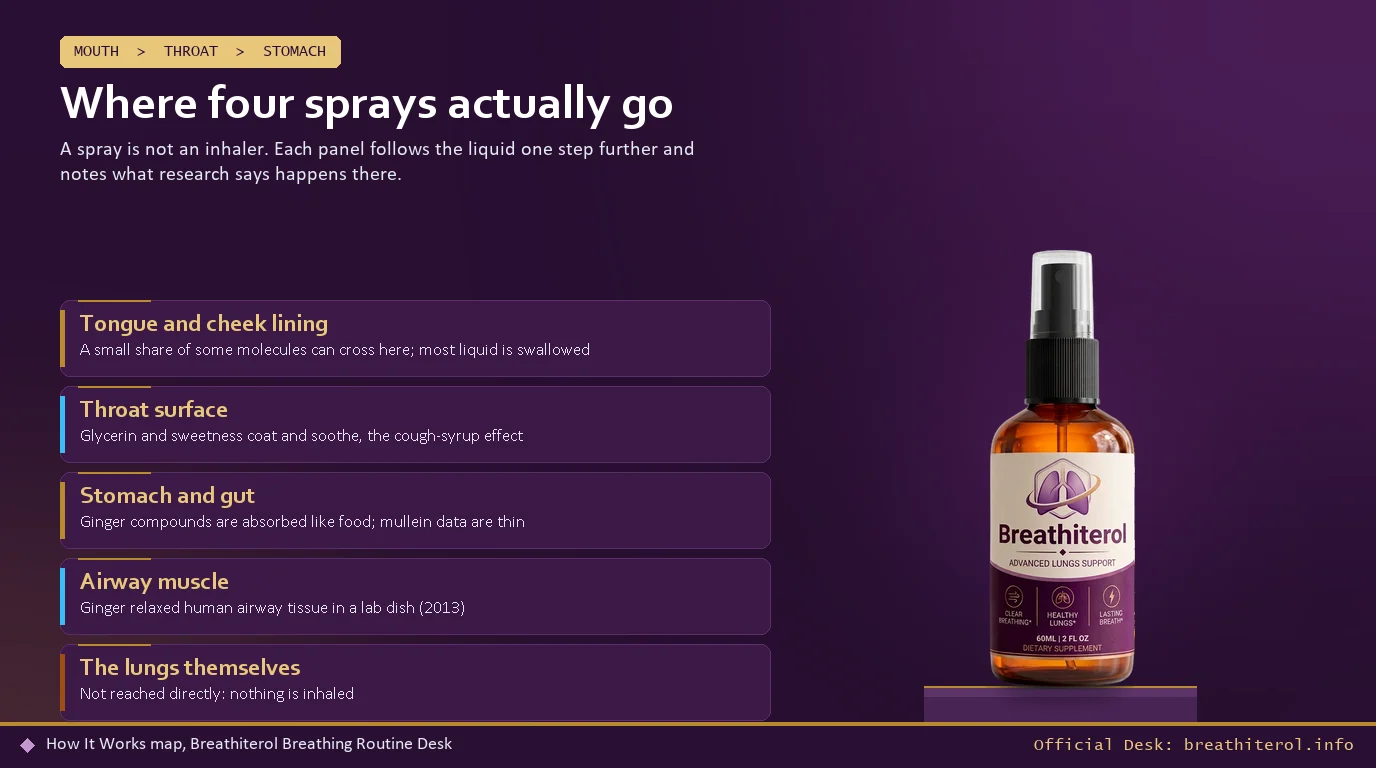
The journey of four sprays
The sales page describes Breathiterol working “directly on the lungs and respiratory pathways.” The easiest way to test that sentence is to follow the liquid. You press the pump four times and 0.60 mL lands on your tongue and the inside of your cheeks. Within a few seconds you swallow. The liquid coats the back of the throat on its way down the esophagus, reaches the stomach, and its plant compounds are digested and absorbed in the gut like those in any herbal tea. Whatever reaches the bloodstream is then carried around the body, the lungs included, in tiny amounts.
At no point does the liquid enter the airways. The windpipe and the food pipe separate at the back of the throat, and swallowing closes the airway on purpose. That is why medicines meant for the lungs come as inhalers, nebulizers or tablets with known blood levels. A spray into the mouth can affect the mouth and throat directly; everything else depends on what is absorbed, and in what quantity.
Stage 1: the mouth lining
The tissue under the tongue and inside the cheeks is thin and rich in blood vessels, so certain drugs, such as nitroglycerin, are given there on purpose. They have something in common: they are small, fat-soluble and potent in tiny doses. Reviews of buccal and sublingual delivery describe the obstacles for everything else: a spray stays in contact for only seconds, saliva dilutes and washes it toward the throat, and most of the dose is swallowed, so absorption is low and unpredictable unless special formulations are used [1].
Plant extracts are mixtures of many compounds, many of them large or water-loving glycosides that cross membranes poorly. A spray like Breathiterol should therefore be thought of as an oral liquid, not as a sublingual drug. There is no study measuring how much of any mullein or ginger compound enters the blood from the mouth after these four sprays.
Stage 2: coating the throat
This is the stage where you are most likely to feel something. Glycerin is a demulcent: it is viscous, it clings to the lining of the mouth and throat, and it eases the scratchy feeling that triggers throat-clearing. Researchers who study cough argue that this coating, together with the sweet taste and the act of swallowing, explains much of the benefit people report from cough syrups, including syrups with no active drug at all [3]. Sweet tastes appear to dampen the cough reflex through pathways in the brain stem, which also helps explain the strong placebo response to syrups [2].
Honey works in a similar way and has better evidence. A systematic review found honey improved cough symptoms in upper respiratory infections compared with usual care [4], and an earlier trial in children found it eased night-time cough and helped sleep [5]. If Breathiterol makes your throat feel better for a while after each use, this is the most likely reason, and it is real, short-lived and shared with cheaper options.
Stage 3: ginger and the airway muscle
The most interesting science behind Breathiterol concerns ginger. In 2013, researchers took strips of human and guinea pig airway smooth muscle, made them contract, and added ginger extract or its pure compounds 6-gingerol, 8-gingerol and 6-shogaol. The strips relaxed, and the effect involved reduced calcium signaling inside the muscle cells, a different route from the beta-agonist inhalers people use for asthma [6]. In mice made allergic to an airborne protein, ginger extract reduced the Th2 immune response and airway inflammation typical of allergic asthma [7].
The same group later ran a small human study: 32 adults with uncontrolled asthma took 1 gram of ginger twice daily or a placebo for 28 days. Exhaled nitric oxide and blood eosinophils, two markers of airway inflammation, did not change. Several measures of daily symptom control did improve, and some inflammatory messengers moved in a favorable direction [8]. That is promising for ginger at 2,000 mg a day. A Breathiterol serving contains at most 77 mg, so this mechanism cannot be assumed to operate at the spray's dose.
Stage 4: the mucus claim
The seller says mullein “loosens and thins mucus buildup in the lungs.” It helps to know how mucus clearance actually works. The airways are lined with a thin mucus layer moved upward by tiny hair-like cilia, the so-called mucociliary escalator. Mucus becomes thicker and harder to clear with dehydration, smoking, infections and chronic conditions such as COPD. What helps is drinking enough fluid, stopping smoking, effective coughing techniques, physical activity and, in disease, specific medicines and airway-clearance devices.
Mullein's reputation as an expectorant comes from its saponins and mucilage and from long folk use. Reviews of the plant list expectorant and anti-inflammatory uses but rely on traditional reports and laboratory work [13] [12]. No study has measured mucus thickness, volume or clearance in people after taking mullein leaf extract by mouth. The claim may be plausible; it is not demonstrated.
Stage 5: the germ claims
The seller also describes the formula as cleansing the respiratory tract of impurities. The laboratory record does contain antimicrobial findings: mullein extracts inhibited bacteria on agar plates [11], a mullein extract blocked an animal herpes virus in cell culture [10], and fresh ginger reduced respiratory syncytial virus activity in human airway cell lines [9]. Those experiments put concentrated extract directly onto microbes or cells. Swallowing tens of milligrams of extract does not recreate those conditions in the lungs.
Lemon's vitamin C connection does not help much either: pure vitamin C at 200 mg or more a day only slightly shortened colds in regular users and did not prevent them in most people [14]. Breathiterol is not a way to prevent or treat respiratory infections.
Claim check: the sales page against the evidence
| Seller's claim | Mechanism offered | What is actually known |
|---|---|---|
| “Works directly on the lungs” | Spray into the mouth | Liquid is swallowed; nothing is inhaled |
| Loosens and thins mucus | Mullein saponins and mucilage | Traditional use and lab data; no human measurement |
| Relaxes airway muscles | Ginger compounds | Shown in lab tissue; one pilot at 2,000 mg a day |
| Reduces chest irritation | Soothing extracts | Glycerin and sweetness soothe the throat briefly |
| “Wheeze-free breathing” | Combined effect | Never measured for this product |
| Clean breath, lasting freshness | Lemon and flavors | Plausible: you can taste it |
Two of the six claims are believable at face value: the throat-soothing effect and the fresh taste. Two rest on interesting science at much higher doses. Two describe effects that a swallowed spray cannot deliver or that nobody has measured.
When would you feel anything?
Because the likely effects come from different stages, they would appear on different timescales. The throat-coating effect of glycerin and sweetness is immediate and fades within minutes to an hour, which matches how people describe syrups: pleasant relief right after a dose, then nothing until the next one. That is real, but it is a comfort effect, and it does not accumulate over weeks.
Any effect from absorbed plant compounds would build more slowly. In the ginger asthma pilot, symptom scores separated from placebo by day 28, at 2,000 mg a day. At the spray's much lower amounts, a slow, cumulative benefit cannot be assumed at all. This is why the desk suggests a written diary with a decision point at day 45: it captures any gradual change without letting a pleasant taste be mistaken for progress.
A practical tip for the diary: note the air quality and whether you had a cold that week. Colds, pollen peaks and smoke days move breathing symptoms far more than any supplement, and without that context a good or bad week is easy to misread.
Why the mechanism matters more if you have a lung condition
For a healthy adult, the gap between what the spray promises and what it can do costs money and some disappointment. For someone with asthma or COPD, the gap can cost more. Those conditions narrow the airways through muscle tightening, swelling and mucus, and the treatments that work deliver medicine to the airway lining in measured doses. A pleasant throat sensation after four sprays can feel like relief while the airways themselves are unchanged.
The risk is substitution: skipping a controller inhaler because the spray “seems to help,” or delaying a visit for a cough that has changed. COPD care relies on inhalers, rehabilitation and sometimes oxygen [24], and none of that has a botanical replacement. If you live with a lung condition and want to try Breathiterol, tell your clinician, keep every medicine as prescribed, and treat the spray as an extra comfort rather than a treatment.
What reliably helps breathing
The desk's job is not only to say what a product cannot do. These are the steps with real evidence, in rough order of impact for most adults:
- Stop smoking or vaping. In the Lung Health Study, people who quit lost lung function much more slowly in the following years than those who kept smoking [15]. Free support is listed by MedlinePlus [16].
- Get a diagnosis for persistent symptoms. A cough lasting weeks, wheeze or breathlessness has causes that can be identified and treated; the American Lung Association lists the warning signs [22], and MedlinePlus explains when breathlessness is urgent [23].
- Join pulmonary rehabilitation if you have chronic lung disease. Supervised exercise and breathing training improve symptoms and daily function [17]; for COPD it is a core part of care [24].
- Practice breathing exercises if you have asthma. A Cochrane review of 22 trials found they may improve quality of life and symptoms [18].
- Manage the air you breathe. Check the AQI and move exertion indoors on bad days [19]; reduce indoor smoke, combustion fumes, mold and dust [20] [21].
A daily herbal spray can sit alongside these as a comfort ritual. It should never be the reason any of them is postponed.
More questions on this page
Does Breathiterol go to the lungs?
Not directly. It is sprayed into the mouth and swallowed, so it reaches the lungs only through the bloodstream, in very small amounts. Inhalers exist precisely because swallowed products cannot target the airways.
Why does my throat feel better after using it?
Most likely because of the glycerin and the sweet taste, which coat the throat and calm the cough reflex for a while. Honey and simple syrups do the same thing.
Is it absorbed under the tongue?
Only a small and unpredictable share, if any. Sprays stay in the mouth for seconds and are mostly swallowed, and plant compounds generally cross the mouth lining poorly.
Can Breathiterol stop wheezing?
There is no evidence that it can. New or worsening wheezing needs a medical assessment, and anyone with asthma should keep a rescue inhaler available.
Does ginger really relax the airways?
In laboratory tissue, yes, and one small asthma pilot found better symptom scores at 2 grams a day. A Breathiterol serving contains 77 mg of ginger at most.
Where these statements come from
Links open the original paper or agency page. Every study tested an ingredient on its own and usually at a bigger dose; none of them used a Breathiterol spray.
- 1Hua S. Advances in nanoparticulate drug delivery approaches for sublingual and buccal administration. Front Pharmacol. 2019;10:1328. pubmed.ncbi.nlm.nih.gov/31827435/
- 2Eccles R. Mechanisms of the placebo effect of sweet cough syrups. Respir Physiol Neurobiol. 2006;152(3):340-348. pubmed.ncbi.nlm.nih.gov/16326149/
- 3Eccles R, Mallefet P. Soothing properties of glycerol in cough syrups for acute cough due to common cold. Pharmacy (Basel). 2017;5(1):4. pubmed.ncbi.nlm.nih.gov/28970416/
- 4Abuelgasim H, Albury C, Lee J. Effectiveness of honey for symptomatic relief in upper respiratory tract infections: a systematic review and meta-analysis. BMJ Evid Based Med. 2021;26(2):57-64. pubmed.ncbi.nlm.nih.gov/32817011/
- 5Paul IM, Beiler J, McMonagle A, et al. Effect of honey, dextromethorphan, and no treatment on nocturnal cough and sleep quality for coughing children and their parents. Arch Pediatr Adolesc Med. 2007;161(12):1140-1146. pubmed.ncbi.nlm.nih.gov/18056558/
- 6Townsend EA, Siviski ME, Zhang Y, et al. Effects of ginger and its constituents on airway smooth muscle relaxation and calcium regulation. Am J Respir Cell Mol Biol. 2013;48(2):157-163. pubmed.ncbi.nlm.nih.gov/23065130/
- 7Khan AM, Shahzad M, Raza Asim MB, et al. Zingiber officinale ameliorates allergic asthma via suppression of Th2-mediated immune response. Pharm Biol. 2015;53(3):359-367. pubmed.ncbi.nlm.nih.gov/25420680/
- 8Emala CW, Saroya TK, Miao Y, Wang S, Sang S, DiMango EA. Low-dose oral ginger improves daily symptom scores in asthma. Pharmaceuticals (Basel). 2024;17(12):1651. pubmed.ncbi.nlm.nih.gov/39770492/
- 9Chang JS, Wang KC, Yeh CF, Shieh DE, Chiang LC. Fresh ginger (Zingiber officinale) has anti-viral activity against human respiratory syncytial virus in human respiratory tract cell lines. J Ethnopharmacol. 2013;145(1):146-151. pubmed.ncbi.nlm.nih.gov/23123794/
- 10Escobar FM, Sabini MC, Zanon SM, Tonn CE, Sabini LI. Antiviral effect and mode of action of methanolic extract of Verbascum thapsus L. on pseudorabies virus (strain RC/79). Nat Prod Res. 2012;26(17):1621-1625. pubmed.ncbi.nlm.nih.gov/21999656/
- 11Turker AU, Camper ND. Biological activity of common mullein, a medicinal plant. J Ethnopharmacol. 2002;82(2-3):117-125. pubmed.ncbi.nlm.nih.gov/12241986/
- 12Gupta A, Atkinson AN, Pandey AK, Bishayee A. Health-promoting and disease-mitigating potential of Verbascum thapsus L. (common mullein): a review. Phytother Res. 2022;36(4):1507-1522. pubmed.ncbi.nlm.nih.gov/35088467/
- 13Turker AU, Gurel E. Common mullein (Verbascum thapsus L.): recent advances in research. Phytother Res. 2005;19(9):733-739. pubmed.ncbi.nlm.nih.gov/16222647/
- 14Hemilä H, Chalker E. Vitamin C for preventing and treating the common cold. Cochrane Database Syst Rev. 2013;(1):CD000980. pubmed.ncbi.nlm.nih.gov/23440782/
- 15Scanlon PD, Connett JE, Waller LA, et al. Smoking cessation and lung function in mild-to-moderate chronic obstructive pulmonary disease: the Lung Health Study. Am J Respir Crit Care Med. 2000;161(2 Pt 1):381-390. pubmed.ncbi.nlm.nih.gov/10673175/
- 16MedlinePlus, U.S. National Library of Medicine. Quitting Smoking. medlineplus.gov/quittingsmoking.html
- 17National Heart, Lung, and Blood Institute. Pulmonary Rehabilitation. www.nhlbi.nih.gov/health/pulmonary-rehabilitation
- 18Santino TA, Chaves GS, Freitas DA, Fregonezi GA, Mendonça KM. Breathing exercises for adults with asthma. Cochrane Database Syst Rev. 2020;3(3):CD001277. pubmed.ncbi.nlm.nih.gov/32212422/
- 19U.S. EPA AirNow. AQI Basics. www.airnow.gov/aqi/aqi-basics/
- 20U.S. Environmental Protection Agency. Introduction to Indoor Air Quality. www.epa.gov/indoor-air-quality-iaq/introduction-indoor-air-quality
- 21American Lung Association. What Makes Indoor Air Unhealthy? www.lung.org/clean-air/indoor-air/indoor-air-pollutants
- 22American Lung Association. Warning Signs of Lung Disease. www.lung.org/lung-health-diseases/warning-signs-of-lung-disease
- 23MedlinePlus Medical Encyclopedia, U.S. National Library of Medicine. Breathing difficulty. medlineplus.gov/ency/article/003075.htm
- 24National Heart, Lung, and Blood Institute. COPD: What Is COPD? www.nhlbi.nih.gov/health/copd
Give Breathiterol a fair, dated trial
The seller takes payment on its BuyGoods checkout; this desk only points the way. Before the first spray, show the label to a pharmacist if you take a blood thinner or diabetes tablets, write down three baseline numbers (morning cough, phlegm, how you feel on the stairs), open a single bottle, and make your keep-or-return call around day 45 so the parcel reaches the seller well inside day 60.