
Breathiterol Ingredients: Mullein, Ginger, Lemon and What 154 mg Can Hold
Three plant extracts, one total and a glycerin base. Here is each ingredient's identity, its range per serving, the seller's claim and the research that actually exists.
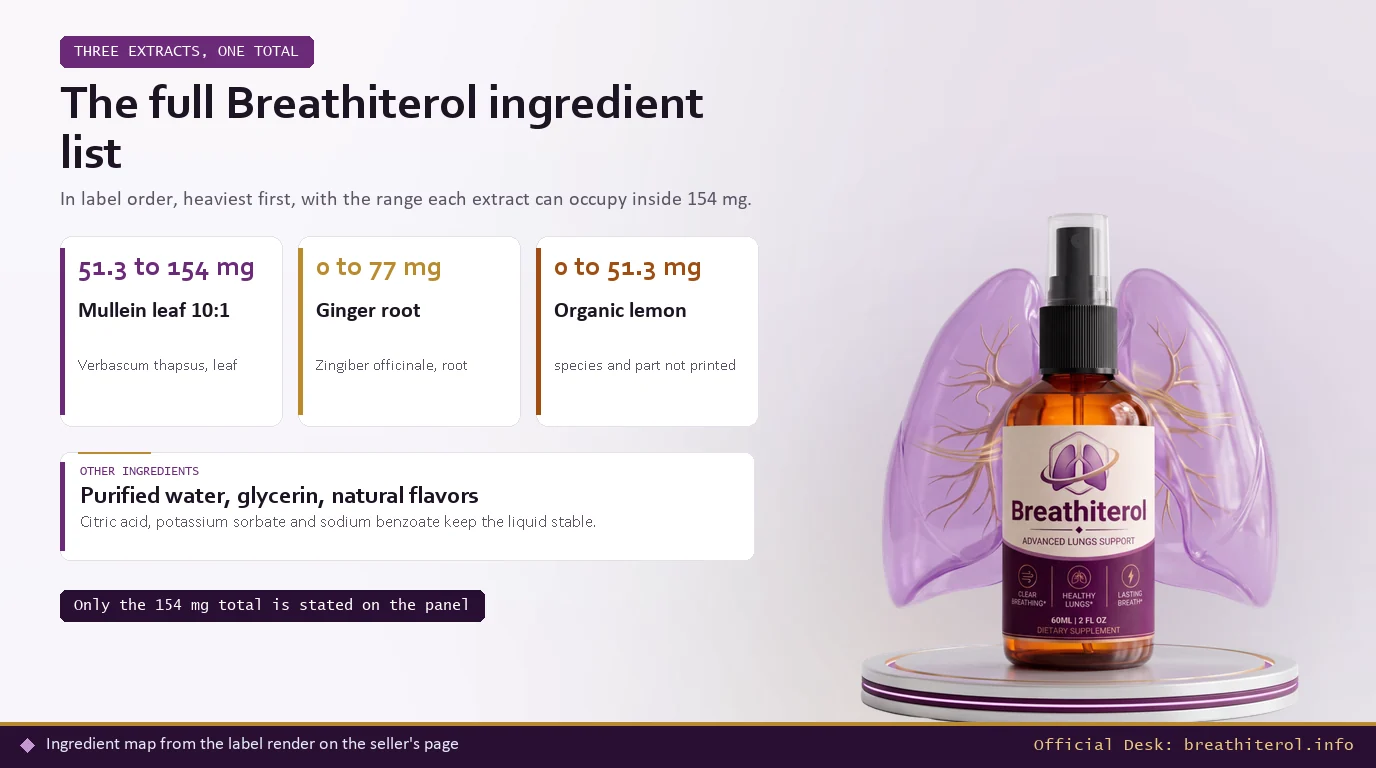
The three extracts and the liquid around them
The Breathiterol panel is short. It names three plant extracts inside one proprietary blend of 154 mg per 4-spray serving, then a base of purified water, glycerin, natural flavors, citric acid, potassium sorbate and sodium benzoate. That brevity is useful: there is nothing hidden behind a list of twenty names, and each ingredient can be looked up properly. The trade-off is that the label never says how the 154 mg is split, so every amount on this page is a range worked out from the label order rather than a figure the seller states [23].
| Ingredient | Identity on the label | Range per serving | Seller's claim | Best human evidence |
|---|---|---|---|---|
| Mullein leaf extract 10:1 | Verbascum thapsus, leaf | 51.3 to 154 mg | Loosens and thins mucus | Ear drops in children (mixed herbs) |
| Ginger root extract | Zingiber officinale, root | 0 to 77 mg | Relaxes airway muscles | Nausea trials; one asthma pilot at 2 g a day |
| Organic lemon extract | not specified | 0 to 51.3 mg | Purifies, freshens breath | None for breathing |
| Glycerin (base) | not quantified | most of 0.60 mL with water | not mentioned | Cough-syrup research on demulcents |
Read the table from right to left and the product comes into focus. The column with the best human evidence points to the base liquid and to ginger at doses far above what the spray carries. The seller's claims column describes effects that have been seen in cell cultures, animals or folk use, but not in people taking this spray.
Mullein leaf extract 10:1: the lead ingredient
Common mullein, Verbascum thapsus, is the tall plant with soft, felted grey-green leaves and a spike of yellow flowers that grows along roadsides across North America and Europe. For centuries both continents used it for coughs: the leaves and flowers were brewed as tea, smoked by some Native American groups and steeped in oil for earaches. A review of Spanish folk medicine documents those respiratory and skin uses in detail and looks for lab support behind them [4].
What is in the leaf
Chemists have found saponins (soap-like compounds that foam in water), mucilage (a slippery gel), iridoid glycosides such as aucubin, flavonoids, and phenylethanoid glycosides, of which verbascoside is the best studied [1]. Saponins and mucilage are the reason mullein has a reputation as an expectorant and a soother: mucilage coats irritated membranes, and saponins are thought to irritate the stomach lining slightly in a way that reflexively increases airway secretions. That reflex theory is old and has never been measured for mullein in people.
What the 10:1 means
A 10:1 ratio says roughly ten units of dried leaf were used to make one unit of extract. Because mullein is listed first in a three-ingredient blend, it weighs at least a third of 154 mg, about 51 mg, which corresponds to around 500 mg of dried leaf. A typical mullein tea uses one to two teaspoons of dried leaf, several grams, so a serving of the spray is in the same territory as a weak cup of tea. The ratio says nothing about which compounds the extraction kept, and the label gives no marker such as verbascoside content.
The research, honestly graded
Most mullein science sits in test tubes. Early work showed extracts inhibiting several bacteria on agar plates [2]. A methanol extract stopped an animal herpes virus from infecting cells [6], and purified verbascoside reduced inflammatory signals in human immune cells grown in a dish [5]. A 2022 review gathers these findings and calls for clinical trials, because none exist for breathing [3].
The only human trials involve ears, not lungs. Two Israeli studies in children with ear pain from otitis media used drops containing mullein together with garlic, calendula and St John's wort in olive oil; the drops eased pain about as well as an anesthetic drop [7] [8]. They tell us nothing about swallowing a leaf extract for the chest.
Europe's herbal committee gives mullein flower, not leaf, a traditional-use monograph for sore throat with dry cough and for the common cold [9]. That status rests on long use, not trials, and it covers a tea made from flowers. It is still the strongest official word on any Breathiterol ingredient for respiratory comfort.
Safety
Mullein is considered low-risk. Its leaf hairs can irritate the throat, which is why teas are strained through cloth; an extract avoids that. Rare skin reactions to the plant have been reported in people who handle it. No drug interactions are well documented.
Ginger root extract: the best-studied of the three
Ginger, Zingiber officinale, is the familiar knobbly root. Its heat comes from gingerols in the fresh root and shogaols, which form when ginger is dried or heated. Those compounds are what researchers measure, and they are what the Breathiterol label does not quantify: there is no extract ratio and no gingerol percentage, so even the 77 mg ceiling tells us little about strength.
Where human evidence is solid
An overview of 109 randomized trials found ginger's most consistent human benefit in nausea and vomiting, with weaker and mixed signals for inflammation markers, blood sugar and lipids [10]. Pregnancy nausea is one of the best-supported uses, with a meta-analysis finding improvement over placebo [11]. Doses in those trials typically run from several hundred milligrams to over a gram of ginger a day.
Airway findings
The airway story is newer and mostly preclinical. Columbia University researchers showed that ginger extract and purified 6-gingerol, 8-gingerol and 6-shogaol relaxed precontracted airway smooth muscle from humans and guinea pigs, by changing calcium handling inside the muscle cells [12]. In allergen-sensitized mice, a ginger extract reduced the Th2-type inflammation that drives allergic asthma [13]. Fresh ginger also showed activity against respiratory syncytial virus in human airway cell lines [14].
The first human test came in 2024: 32 adults with uncontrolled asthma took 1 gram of ginger twice a day or placebo for 28 days. Exhaled nitric oxide and blood eosinophils did not change, but several daily symptom scores improved and some inflammatory messengers shifted [15]. That is a small pilot, at 2,000 mg a day. A Breathiterol serving can contain 77 mg at most.
Regulatory view
Europe's herbal committee recognizes powdered ginger for preventing motion-sickness nausea on well-established use, and for common-cold symptoms only on tradition [16].
Safety
In food and supplement amounts ginger is generally safe; heartburn, burping and mild stomach upset are the usual complaints [18]. A systematic review found inconsistent evidence that ginger affects platelets in people [17], but cautious advice remains standard with anticoagulants, antiplatelet drugs and before surgery. Memorial Sloan Kettering's herb database lists the same points and notes a possible small effect on blood sugar [19].
Organic lemon extract: flavor first
“Organic lemon extract” can mean several different things: a peel extract rich in flavonoids such as hesperidin and eriocitrin, a concentrated juice, or a flavoring made from lemon oil. The label does not say which, does not give a species name or plant part, and does not give a ratio. The “organic” claim refers to farming, not to strength.
The sales page credits lemon with purifying the upper airway and neutralizing odors. No human study tests a lemon extract for breathing or lung health. Lemon is often associated with vitamin C, but the vitamin C research on colds used 200 mg or more of pure ascorbic acid a day, and even then regular use only shortened colds slightly and did not prevent them in the general population [20]. A lemon extract inside a 154 mg blend provides, at most, a few milligrams of vitamin C, if any.
What lemon does do is make the liquid taste better. Mullein is grassy and ginger is sharp; a citrus note and some acidity turn that into something people will take every morning. In a product whose main benefit is likely to be a soothing daily ritual, that matters more than it sounds.
The base: water, glycerin, flavors and preservatives
By volume, most of each 0.60 mL serving is the carrier. It deserves attention because it is the part most likely to produce a sensation you notice.
Glycerin is a thick, sweet liquid used in nearly every cough syrup. Respiratory researchers argue that its lubricating, coating and demulcent action explains much of why people feel relief from syrups for acute cough, independent of any active drug [22]. Sweetness itself seems to quiet the cough reflex through brain-stem pathways, which is part of the well-known placebo power of syrupy remedies [21].
Natural flavors are not specified. Citric acid adjusts taste and acidity. Potassium sorbate and sodium benzoate are preservatives that stop mold and bacteria from growing once the pump has been used; both are common in drinks and syrups and are generally well tolerated, although a small number of people react to benzoates. The label asks you to keep the bottle away from heat, light and humidity, which also protects the preservatives.
What Breathiterol does not contain
Shoppers comparing lung products often see the same handful of ingredients elsewhere. Breathiterol contains none of the following: N-acetylcysteine (a mucus-thinning compound used as a medicine in some countries), quercetin, bromelain, vitamin D, zinc, elderberry, thyme, ivy leaf, eucalyptus oil or menthol. It has no stimulants and no caffeine. If you are already taking any of those, Breathiterol does not duplicate them; if you are looking for one of them specifically, this is not that product.
There is also no honey, even though honey is one of the few home remedies with decent evidence for cough relief in upper respiratory infections. The glycerin base plays a similar soothing role without the sugar.
Evidence grades for each ingredient
The desk grades evidence on a simple scale: A for consistent human trials at the dose in the product, B for human trials at higher doses, C for small or indirect human data, D for laboratory, animal or traditional use only.
| Ingredient | Grade | Why |
|---|---|---|
| Glycerin base (soothing) | B | Demulcent effect supported by cough-syrup research, not tested in this spray |
| Ginger root (airway comfort) | C | One 32-person pilot at 26 times the spray's ceiling; strong lab data |
| Ginger root (nausea) | B | Many trials, but at doses above the spray's ceiling; not the reason people buy it |
| Mullein leaf 10:1 (mucus, cough) | D | Lab and folk data; regulator accepts the flower tea on tradition only |
| Organic lemon (purifying) | D | No study; flavor and acidity are its real roles |
No ingredient reaches grade A, and that is the plainest summary of the spray. It is a reasonable choice for someone who wants a pleasant, low-risk herbal routine and understands that the science is early. It is the wrong choice for anyone expecting measurable changes in lung function.
More questions on this page
Which Breathiterol ingredient is strongest?
Mullein leaf extract 10:1 is listed first, so it is the largest by weight, at least 51.3 mg per serving. Ginger has the most human research, but a serving holds 77 mg of it at most.
Is mullein leaf the same as mullein flower?
No. Breathiterol uses leaf extract. Europe's traditional-use monograph covers mullein flower tea for sore throat with dry cough, and the two parts differ in composition.
Does Breathiterol contain vitamin C?
Not in any meaningful amount. Organic lemon extract is listed, but no vitamin C appears on the panel, and the blend leaves room for at most about 51 mg of lemon extract in total.
Is there sugar or alcohol in Breathiterol?
Neither is listed. The sweetness comes from glycerin and natural flavors, and the preservatives are potassium sorbate and sodium benzoate.
Can I take ginger capsules instead?
You can, and they reach studied doses more easily, often 250 to 500 mg per capsule. Check with a pharmacist first if you take a blood thinner or diabetes medicine.
Where these statements come from
Links open the original paper or agency page. Every study tested an ingredient on its own and usually at a bigger dose; none of them used a Breathiterol spray.
- 1Turker AU, Gurel E. Common mullein (Verbascum thapsus L.): recent advances in research. Phytother Res. 2005;19(9):733-739. pubmed.ncbi.nlm.nih.gov/16222647/
- 2Turker AU, Camper ND. Biological activity of common mullein, a medicinal plant. J Ethnopharmacol. 2002;82(2-3):117-125. pubmed.ncbi.nlm.nih.gov/12241986/
- 3Gupta A, Atkinson AN, Pandey AK, Bishayee A. Health-promoting and disease-mitigating potential of Verbascum thapsus L. (common mullein): a review. Phytother Res. 2022;36(4):1507-1522. pubmed.ncbi.nlm.nih.gov/35088467/
- 4Blanco-Salas J, Hortigón-Vinagre MP, Morales-Jadán D, Ruiz-Téllez T. Searching for scientific explanations for the uses of Spanish folk medicine: a review on the case of mullein (Verbascum, Scrophulariaceae). Biology (Basel). 2021;10(7):618. pubmed.ncbi.nlm.nih.gov/34356473/
- 5Speranza L, Franceschelli S, Pesce M, et al. Antiinflammatory effects in THP-1 cells treated with verbascoside. Phytother Res. 2010;24(9):1398-1404. pubmed.ncbi.nlm.nih.gov/20812283/
- 6Escobar FM, Sabini MC, Zanon SM, Tonn CE, Sabini LI. Antiviral effect and mode of action of methanolic extract of Verbascum thapsus L. on pseudorabies virus (strain RC/79). Nat Prod Res. 2012;26(17):1621-1625. pubmed.ncbi.nlm.nih.gov/21999656/
- 7Sarrell EM, Mandelberg A, Cohen HA. Efficacy of naturopathic extracts in the management of ear pain associated with acute otitis media. Arch Pediatr Adolesc Med. 2001;155(7):796-799. pubmed.ncbi.nlm.nih.gov/11434846/
- 8Sarrell EM, Cohen HA, Kahan E. Naturopathic treatment for ear pain in children. Pediatrics. 2003;111(5 Pt 1):e574-e579. pubmed.ncbi.nlm.nih.gov/12728112/
- 9European Medicines Agency, Committee on Herbal Medicinal Products. Verbasci flos (mullein flower): herbal medicinal product summary and monograph. www.ema.europa.eu/en/medicines/herbal/verbasci-flos
- 10Anh NH, Kim SJ, Long NP, et al. Ginger on human health: a comprehensive systematic review of 109 randomized controlled trials. Nutrients. 2020;12(1):157. pubmed.ncbi.nlm.nih.gov/31935866/
- 11Viljoen E, Visser J, Koen N, Musekiwa A. A systematic review and meta-analysis of the effect and safety of ginger in the treatment of pregnancy-associated nausea and vomiting. Nutr J. 2014;13:20. pubmed.ncbi.nlm.nih.gov/24642205/
- 12Townsend EA, Siviski ME, Zhang Y, et al. Effects of ginger and its constituents on airway smooth muscle relaxation and calcium regulation. Am J Respir Cell Mol Biol. 2013;48(2):157-163. pubmed.ncbi.nlm.nih.gov/23065130/
- 13Khan AM, Shahzad M, Raza Asim MB, et al. Zingiber officinale ameliorates allergic asthma via suppression of Th2-mediated immune response. Pharm Biol. 2015;53(3):359-367. pubmed.ncbi.nlm.nih.gov/25420680/
- 14Chang JS, Wang KC, Yeh CF, Shieh DE, Chiang LC. Fresh ginger (Zingiber officinale) has anti-viral activity against human respiratory syncytial virus in human respiratory tract cell lines. J Ethnopharmacol. 2013;145(1):146-151. pubmed.ncbi.nlm.nih.gov/23123794/
- 15Emala CW, Saroya TK, Miao Y, Wang S, Sang S, DiMango EA. Low-dose oral ginger improves daily symptom scores in asthma. Pharmaceuticals (Basel). 2024;17(12):1651. pubmed.ncbi.nlm.nih.gov/39770492/
- 16European Medicines Agency, Committee on Herbal Medicinal Products. Zingiberis rhizoma (ginger): herbal medicinal product summary and monograph. www.ema.europa.eu/en/medicines/herbal/zingiberis-rhizoma
- 17Marx W, McKavanagh D, McCarthy AL, et al. The effect of ginger (Zingiber officinale) on platelet aggregation: a systematic literature review. PLoS One. 2015;10(10):e0141119. pubmed.ncbi.nlm.nih.gov/26488162/
- 18National Center for Complementary and Integrative Health. Ginger: Usefulness and Safety. www.nccih.nih.gov/health/ginger
- 19Memorial Sloan Kettering Cancer Center, About Herbs. Ginger. www.mskcc.org/cancer-care/integrative-medicine/herbs/ginger
- 20Hemilä H, Chalker E. Vitamin C for preventing and treating the common cold. Cochrane Database Syst Rev. 2013;(1):CD000980. pubmed.ncbi.nlm.nih.gov/23440782/
- 21Eccles R. Mechanisms of the placebo effect of sweet cough syrups. Respir Physiol Neurobiol. 2006;152(3):340-348. pubmed.ncbi.nlm.nih.gov/16326149/
- 22Eccles R, Mallefet P. Soothing properties of glycerol in cough syrups for acute cough due to common cold. Pharmacy (Basel). 2017;5(1):4. pubmed.ncbi.nlm.nih.gov/28970416/
- 23Electronic Code of Federal Regulations. 21 CFR 101.36: Nutrition labeling of dietary supplements (proprietary blend rule in paragraph (c)). www.ecfr.gov/current/title-21/chapter-I/subchapter-B/part-101/subpart-C/section-101.36
Give Breathiterol a fair, dated trial
The seller takes payment on its BuyGoods checkout; this desk only points the way. Before the first spray, show the label to a pharmacist if you take a blood thinner or diabetes tablets, write down three baseline numbers (morning cough, phlegm, how you feel on the stairs), open a single bottle, and make your keep-or-return call around day 45 so the parcel reaches the seller well inside day 60.